

No Country For Old Men (2007): ***½
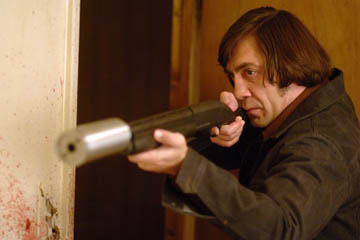
Directed by Joel & Ethan Coen
I'm going to have to describe this move in unfortunately vague terms, because I dare not give away anything that happens. Make no mistake: you will not be able to predict No Country For Old Men.
The movie is essentially about a group of disparate characters who find themselves confronted with a character who he is simply out of everyone's league: Anton Chigurh (played by Javier Bardem, who just won an Oscar for doing so). It's almost as if these characters think they're in a specific type of movie, but they are consistently confounded by this man who is in another type of movie entirely--his own. These characters are all established, have their own ways of thinking, and have their own views on how the world works. Chigurh refuses to play along with any of it. He lives by his own "code" of sorts, and is so absolutely relentless and implacable that he plows right through everyone's preconceived notions.
No Country For Old Men plays with themes similar to some of the Coen Brothers' other works (especially Blood Simple and Fargo): Fate and Chance. Chigurh is a curious mix of a fatalist and a man who believes in luck. He honestly believes that if he's come across your path, then it is very likely that this is the time that you've been fated to die. He just happens to be the instrument. His victims often tell him, "You don't have to do this." He disagrees, seeing himself as the hand of fate. And yet he also sometimes offers people a chance: a coin flip. Win and you live; lose and you die.
The movie similarly balances between fate and chance. Some events in the movie seem so perfectly orchestrated that they couldn't possibly have happened by chance. And then on the other hand some things happen completely out of the blue, seemingly by random.
No Country For Old Men is different from a lot of the Coen brothers' other works in that it is a little bit less insular. The particular characters and locations of the story are very much their own style and the people have their own ways of talking and thinking, just like the rest of the Coens' work. But this movie, more than almost any other Coen Bros film I can think of, exists in the "real world." It is, in fact, important to the plot at times that these characters exist in a wider world than just their own scope of experience. In many of the Coen films, the worlds are so self-contained that there is no real room for any outside interference. No Country For Old Men seems like it is going to be another one of those movies, but then periodically things pop in from the outside world that on occasion completely ruin the characters' plans. They're all acting like they're in a tight, self-contained screenplay, and it's almost like they keep on stumbling over cracks to the "outside" world, sometimes with shocking and disastrous consequences. The characters all think that they know all of the information, and if this were indeed like a typical Coen movie then they no doubt would be correct. But the events of the story hinge on them each only knowing a specific and incomplete part of the whole, which (again) leads sometimes to disastrous consequences. It's these little leaks, these little moments of chance and outside interference that make No Country For Old Men absolutely unpredictable.
Yet I didn't give it four stars? Correct. It is a fascinating, moody film, but ultimately its almost reflective tone kept me pretty consistently at a certain distance from what was going on. It felt like I was watching a movie rather than experiencing the events of the movie for myself. This is not an unusual thing for a Coen Bros movie (Hudsucker Proxy is perhaps one of the most mannered and distant movies they've ever made), but usually in those cases the artifice of the movie itself is unbelievably enjoyable. But No Country For Old Men is made simply and in a straight-forward fashion in a way that doesn't call attention to itself. It is thoroughly enjoyable, and a lot of really interesting things happen, but I did not leave the theater thinking, "OMGooses that was absolutely incredible!" I left thinking, "That was enjoyable and a lot of really interesting things happened."
Was it the best film of the year (as the Academy would have you
believe)? I didn't think so by any means. But then again, the Academy
didn't even nominate Grindhouse
or Hot Fuzz (my two favorite
movies of 2007) for best picture, so what do I know?